
- Jul 12, 2026
- admin
- 0
Retry Mechanism in Playwright
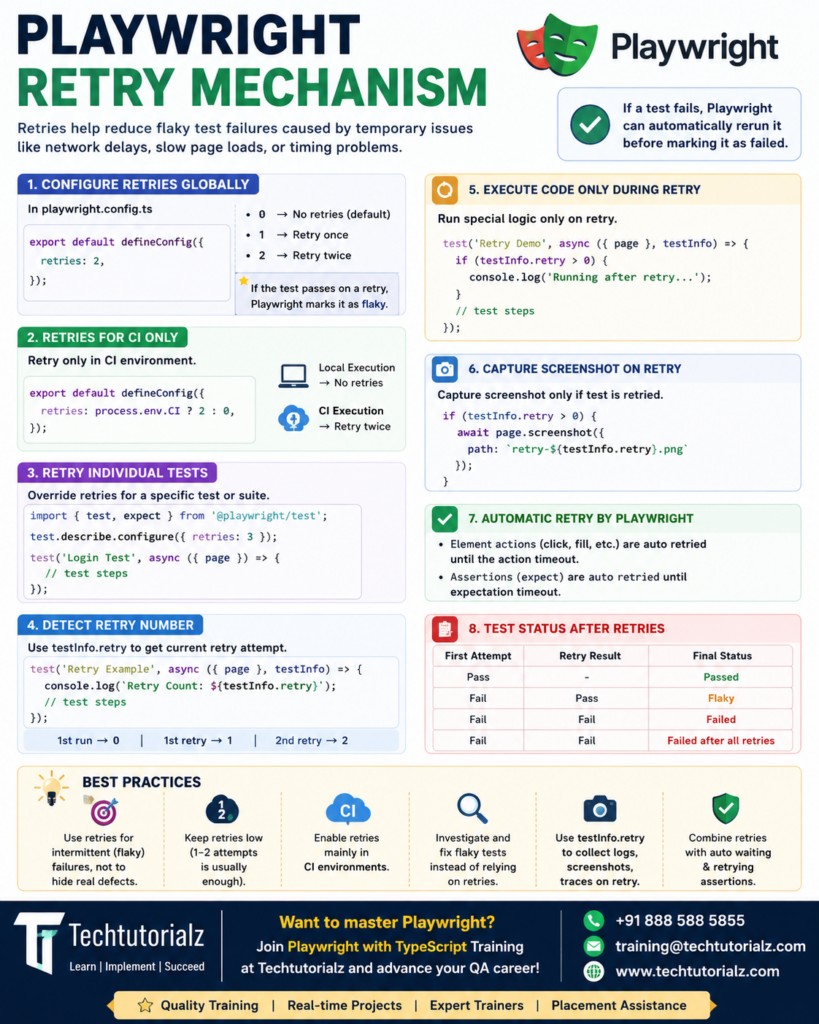
Retries in Playwright help reduce flaky test failures caused by temporary issues such as network delays, slow page loads, or timing problems. If a test fails, Playwright can automatically rerun it before marking it as failed.
- Configure Retries Globally
In playwright.config.ts:
import { defineConfig } from ‘@playwright/test’;
export default defineConfig({
retries: 2,
});
Behavior:
- 0 → No retries (default)
- 1 → Retry once after failure
- 2 → Retry twice after failure
If the test passes on a retry, Playwright marks it as flaky.
- Configure Retries for CI Only
A common practice is to retry only in CI.
import { defineConfig } from ‘@playwright/test’;
export default defineConfig({
retries: process.env.CI ? 2 : 0,
});
- Local execution → No retries
- CI execution → Retry twice
- Retry Individual Tests
You can override retries for a specific test or suite.
import { test, expect } from ‘@playwright/test’;
test.describe.configure({ retries: 3 });
test(‘Login Test’, async ({ page }) => {
await page.goto(‘https://example.com’);
await expect(page).toHaveTitle(/Example/);
});
- Detect Retry Number
Playwright provides retry information through testInfo.
import { test, expect } from ‘@playwright/test’;
test(‘Retry Example’, async ({ page }, testInfo) => {
console.log(`Retry Count: ${testInfo.retry}`);
await page.goto(‘https://example.com’);
expect(await page.title()).toContain(‘Example’);
});
Output:
Retry Count: 0
If it fails:
Retry Count: 1
Second retry:
Retry Count: 2
- Execute Some Code Only During Retry
test(‘Retry Demo’, async ({ page }, testInfo) => {
if (testInfo.retry > 0) {
console.log(“Running after retry…”);
}
await page.goto(‘https://example.com’);
});
Useful for:
- Taking extra logs
- Clearing cache
- Resetting test data
- Capture Screenshot Only on Retry
test(‘Retry Screenshot’, async ({ page }, testInfo) => {
if (testInfo.retry > 0) {
await page.screenshot({
path: `retry-${testInfo.retry}.png`
});
}
await page.goto(‘https://example.com’);
});
- Retry Failed API Calls (Custom Logic)
Retries apply to tests, not individual API requests. You can implement request retries yourself.
async function getUser(request) {
for (let i = 1; i <= 3; i++) {
const response = await request.get(‘/users’);
if (response.ok()) {
return response;
}
console.log(`Attempt ${i} failed`);
}
throw new Error(“API Failed”);
}
- Retry Clicking an Element
Normally, Playwright automatically retries actions until the action timeout expires.
await page.locator(‘#submit’).click();
Playwright waits until the element is:
- Visible
- Stable
- Enabled
- Receives events
So you usually don’t need manual retry logic for clicks.
- Retry Assertions
Playwright assertions automatically retry until the expectation timeout.
await expect(page.locator(‘.success’))
.toHaveText(‘Order Placed’);
This keeps checking until:
- Text matches, or
- Timeout is reached.
- Retry Entire Test Example
import { test, expect } from ‘@playwright/test’;
test.describe.configure({ retries: 2 });
test(‘Login Example’, async ({ page }, testInfo) => {
console.log(`Retry Number: ${testInfo.retry}`);
await page.goto(‘https://opensource-demo.orangehrmlive.com/’);
await page.locator(‘input[name=”username”]’).fill(‘Admin’);
await page.locator(‘input[name=”password”]’).fill(‘admin123’);
await page.locator(‘button[type=”submit”]’).click();
await expect(page.locator(‘h6’)).toHaveText(‘Dashboard’);
});
Test Status After Retries
| First Attempt | Retry Result | Final Status |
| Pass | – | Passed |
| Fail | Pass | Flaky |
| Fail | Fail | Failed |
| Fail | Fail | Failed after all retries |
Best Practices
- ✅ Use retries for intermittent (flaky) failures, not to hide real defects.
- ✅ Keep retries low (1–2 attempts is usually enough).
- ✅ Enable retries mainly in CI environments.
- ✅ Investigate and fix flaky tests instead of relying on retries.
- ✅ Use testInfo.retry to collect additional diagnostics (screenshots, logs, traces) on retry attempts.
- ✅ Combine retries with Playwright’s automatic waiting and retrying assertions rather than adding unnecessary manual retry loops.
Master Playwright from Scratch! Explore our complete Playwright Tutorial collection covering:
- Playwright Basics
- Locators
- Assertions
- Timeouts
- Browser Context
- Frames & iFrames
- Auto Waiting & Timeouts
- API Testing
- Network Interception
- Authentication
- Fixtures
- Parallel Execution
- CI/CD
- AI in Playwright
👉 Browse all Playwright tutorials: Playwright Tutorial